
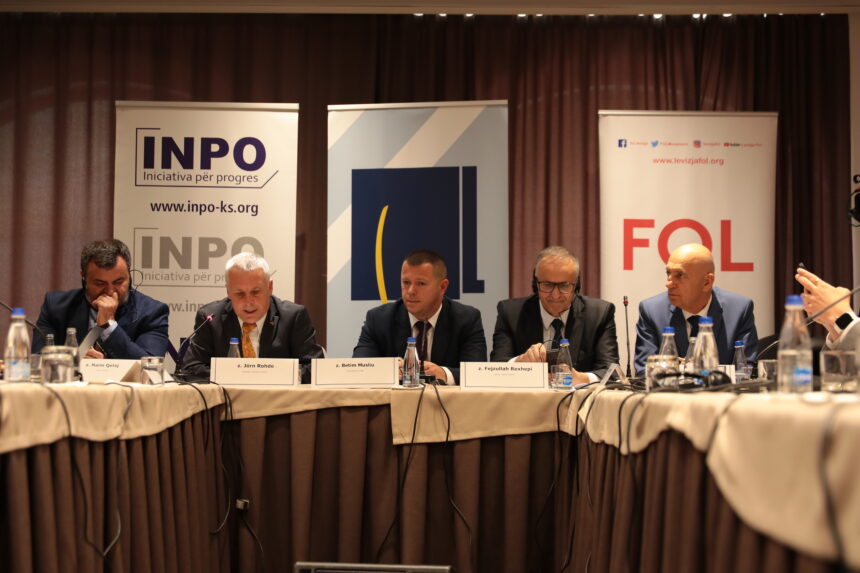
Pristina, 28 May 2025 – The Kosovo Law Institute (KLI), Levizja FOL, and Initiative for Progress (INPO), with the support of the German Embassy in Pristina, organized a roundtable discussion to present the report: “The Application of ECtHR Jurisprudence in Kosovo.”
The event brought together the German Ambassador to Kosovo, Joern Rohde; the President of the Supreme Court, Fejzullah Rexhepi; the Acting Chief State Prosecutor, Besim Kelmendi; the Ombudsperson, Naim Qelaj; representatives of EU institutions in Kosovo; and members of the justice sector and civil society.
The roundtable was opened by Ehat Miftaraj, Executive Director of KLI, and Ambassador Joern Rohde.
Director Miftaraj emphasized the importance of Kosovo’s potential membership in the Council of Europe, stating: “I have stressed that if Kosovo were to join the Council of Europe, we would have the opportunity—within the first year of membership, provided we have constituted institutions such as the Assembly and Government—to ratify and submit dozens of conventions to the Council of Europe,” he said.
According to Miftaraj, a promotional video and the report outlining the benefits of Kosovo’s accession to the Council of Europe will be shared with the Prime Minister, members of parliament, and ministers.
German Ambassador Joern Rohde, expressing his satisfaction with the discussion, said the report provides valuable insights regarding judges’ reference to the European Convention on Human Rights (ECHR):
“Only 13% of cases refer to the Convention, and with proceedings lasting on average three and a half years, this exceeds what is considered a reasonable time under the Convention,” Rohde stated.
The Ambassador also urged Kosovo’s institutions to meet their obligations concerning the dialogue and the establishment of the Association of Serb-Majority Municipalities.
Fejzullah Rexhepi, President of the Supreme Court, acknowledged that while the justice system is not in its best condition, it has reached a stage where judicial maturity is required:
“The system is not in its best condition, but it has reached a stage where it needs maturity. By maturity, I mean that judges must focus on decision-making and the full implementation of human rights and freedoms — meaning they must not issue decisions that contradict the practices of the ECtHR,” Rexhepi said.
Acting Chief State Prosecutor Besim Kelmendi addressed one of the report’s key findings—ensuring trials within a reasonable time frame. He noted that the 2022 Criminal Procedure Code introduced strict deadlines for prosecution and courts:
“We immediately worked to change the approach of prosecution offices in line with these deadlines,” Kelmendi said, adding that he issued a binding instruction to ensure compliance.
Ombudsperson Naim Qelaj pointed out that prosecutors and police in many cases act contrary to ECtHR practices by limiting suspects’ right to communicate with their lawyers during questioning or investigation stages:
“We have observed that in many cases, prosecutors and the police restrict the suspect’s right to consult with counsel, which contradicts ECtHR standards,” Qelaj emphasized.
The report was presented by Gzim Shala, Senior Researcher at KLI, who explained that the findings were based on monitoring 100 court sessions and analyzing 200 judicial decisions. The results indicate a low level of application of ECtHR jurisprudence in Kosovo’s courts.
According to the report, ECtHR jurisprudence was referenced in only one civil and one criminal case during monitored sessions, both cited by judges. In judicial decisions, ECtHR jurisprudence appeared most frequently in civil cases (18.7%), followed by administrative (10%) and criminal cases (8.7%).
This roundtable was held within the framework of the project “Preparing Kosovo’s Institutions for the Implementation of the European Court of Human Rights Jurisprudence”, funded by the German Embassy in Pristina.
The published report can be found at this link.