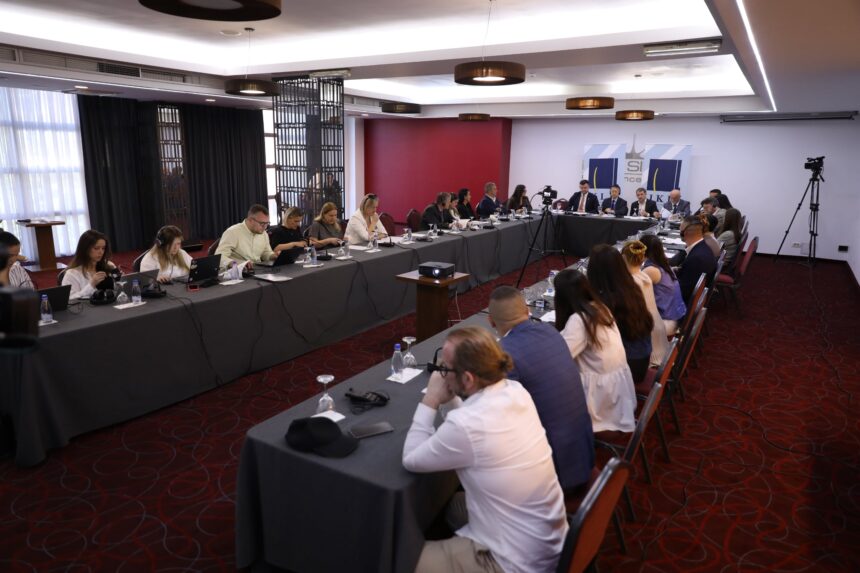
Prishtina, June 4, 2025 – The Kosovo Law Institute (KLI) organized a roundtable discussion to mark the publication of the report “Judicial Efficiency in Practice and Linguistic Rights in the Judicial System.”
The event gathered the Deputy Special Representative of the UN Secretary-General in Kosovo, Milbert Dongjoon Shin; the Supervising Judge at the Basic Court of Prishtina – Gracanica Branch, Sinisha Borisavljevic; Judge at the Basic Court of Prishtina, Përparim Zeka; Deputy Ombudsperson, Niman Hajdari; Attorney Yll Zekaj; representatives from the U.S. Embassy in Kosovo, the Council of Europe Office, the EU Office in Kosovo, as well as justice institutions and civil society representatives.
The roundtable was opened by KLI’s Executive Director, Ehat Miftaraj, and UNMIK’s Deputy SRSG, Milbert Dongjoon Shin.
Director Miftaraj emphasized that the project was particularly meaningful as it was implemented by KLI’s Serbian community colleagues, underscoring that “cooperation in Kosovo is possible when there is genuine commitment to achieving results and overcoming barriers in building a multiethnic society.”
Deputy SRSG Shin highlighted that the report’s findings should be taken seriously by all justice stakeholders. “It should be taken into consideration by all parties of interest. As a jurist, I have noticed that the commentaries should also be translated into the Serbian language,” he noted.
Judge Borisavljevic underlined the need for improved working conditions within the judiciary, especially given the presence of multiple communities and varying levels of trust in the justice system. He thanked KLI and its monitors for their valuable work, noting that “Thanks to you and your contribution, the Judicial Council has raised awareness, and all of this has functioned in the best possible way. Not all parties will be satisfied after the conclusion of a court hearing, but we must strive for the best possible outcome and remain in the service of citizens and institutions.”
Judge Përparim Zeka stressed that the report addresses one of the most fundamental yet underestimated rights in judicial proceedings – the right to translation and interpretation. He described the report as “a concrete contribution not only in identifying translation and interpretation issues but also in raising deeper questions about procedural equality.”
Deputy Ombudsperson Niman Hajdari stated that the use of one’s native language in judicial procedures is a constitutional and international right, adding that “violations of this right cannot be justified by a lack of budgetary resources.”
Meanwhile, Attorney Yll Zekaj stated that there are problems with the younger generations from the Serbian community, due to the small number of them entering the legal profession, whether in advocacy, the judiciary, or the prosecution service.
“We see unfilled competitions due to judicial barriers. We notice that only a small number of them even complete the bar exam because of these barriers. We still lack literature for exam preparation, and we still do not have adequate training for exam preparation—speaking specifically about the Serbian community. And this hinders entry into the profession,” Zekaj stated.
The report was presented by KLI Senior Researcher Arrita Rezniqi, who explained that 226 court hearings were monitored over a seven-month period, enabling identification of procedural practices and challenges affecting judicial efficiency. She noted that while the translation of case files was terminologically accurate, it often lacked clarity in linguistic interpretation, affecting parties’ procedural understanding.
Rezniqi stressed that “poor translation quality directly undermines procedural rights. Translation must be treated as a substantive guarantee, not merely a formal requirement.” She added that interpretation during hearings was consistently provided in the monitored cases, ensuring procedural fairness despite linguistic differences.
Rezniqi also stated that, unlike the issue of case files, the monitoring found that the need to provide translation or interpretation during court sessions was not an obstructive factor. This means that in all cases monitored in the Special Department, interpreters were provided, allowing the normal conduct of proceedings despite language differences.
Pointing out that translation challenges in Kosovo’s judicial system result from a combination of factors—particularly the lack of budget and professional capacities—Rezniqi also said that “there is a need to address this issue in a sustainable manner, which requires the development of a long-term strategy that includes increased investment in legal translation, building professional capacities for young people in this field, as well as integrating the Serbian language into training for the administration and the judicial system.”
The report “Judicial Efficiency in Practice and Linguistic Rights in the Judicial System” presents an in-depth analysis of monitored cases from the Special Department of the Basic Court in Prishtina and the General Department of the Basic Court in Prishtina – Gracanica Branch.
The published report can be found at this link.