
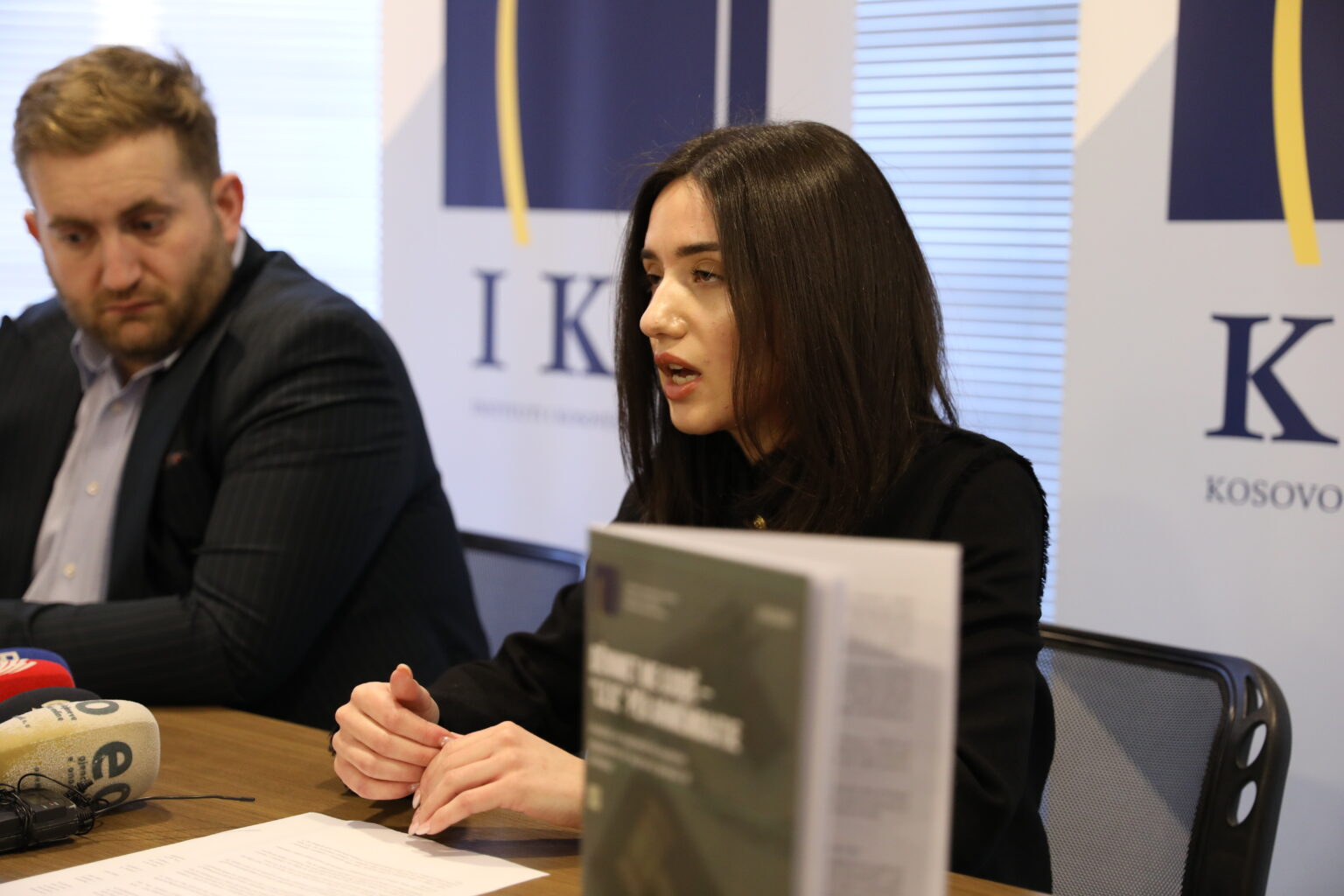
Pristina, February 21, 2025 – The Kosovo Law Institute (KLI), through a press conference, published the report titled “Fines as ‘Permits’ for Gun Possession,” which presents an analysis of court cases dealing with firearms-related criminal offenses. Specifically, the report includes findings from the review of 150 judgments from seven Basic Courts and 46 judgments from the Court of Appeals.
The conference was opened by Gzim Shala, Senior Researcher at KLI, while the findings of the report were presented by Zamira Krasniqi, KLI Researcher.
Krasniqi discussed the report’s findings on sentencing policies, stating that in 147 cases of unauthorized possession of weapons, courts imposed 128 fines, 18 suspended sentences, and only one imprisonment sentence.
Among other findings, Krasniqi emphasized that the amount of fines remains low compared to the maximum penalties prescribed by the Criminal Code of the Republic of Kosovo. According to her, the average fine was €623 in 2022, €601 in 2023, and €857 in 2024.
“Considering these averages, the courts have ignored the legal sanctions for this offense — punishable by a fine of up to €7,500 and up to five years of imprisonment. The imposed sentences reflect a pattern of non-legal, template-based practices adopted by the courts rather than individualized, lawful judgments based on the circumstances and specifics of each case,” stated Krasniqi.
Regarding the qualification of criminal offenses, Krasniqi noted that in six cases, the State Prosecutor filed indictments only for use of a weapon, excluding unauthorized possession, while in some instances, the opposite occurred.
“KLI identified three cases where the State Prosecutor filed an indictment solely for unauthorized possession of a weapon, even though the indictment’s dispositive section explicitly mentioned the use of the weapon. Consequently, the court convicted the accused for one offense and acquitted them for the other,” she explained.
Concerning mitigating circumstances, it was found that plea admission was applied in 145 cases, remorse in 76 cases, and impunity in 75 cases.
On the issue of recidivism, KLI’s findings show that in five cases, individuals charged with unauthorized possession of weapons had previous convictions for other criminal offenses but were again only fined.
The report highlights that courts failed to comply with the Supreme Court’s Sentencing Policy Guidelines, as the Basic Courts did not consider the purposes of punishment outlined in the guidelines but merely cited them without explaining the connection between the stated purposes and the imposed penalties.
Furthermore, KLI found that in four cases, courts did not order the confiscation of the weapon, thereby failing to enforce the legal obligation to remove the weapon from circulation.
Finally, Krasniqi noted that in 11 cases where the State Prosecutor appealed the type or severity of the sentence, the Court of Appeals rejected the appeal in five cases and modified the lower court’s decision in six cases — in all instances changing only the fine amount, without imposing any effective prison sentence.
The report concludes that the Court of Appeals also showed no willingness to change the long-standing practice of the Basic Courts, effectively accepting the imposition of fines for unauthorized weapon possession as a standard judicial practice