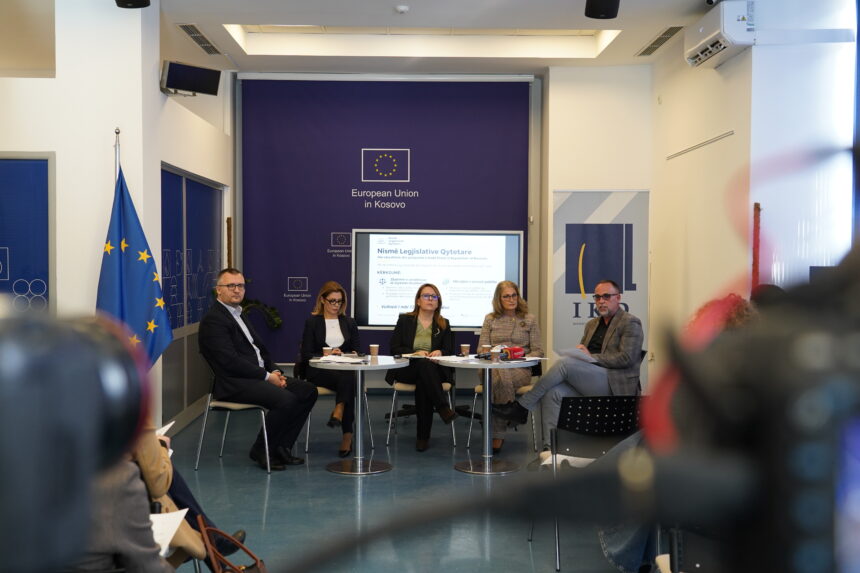
Pristina, 18 November 2026 – On Wednesday, the Kosovo Law Institute (KLI), with the support of the Embassy of the Federal Republic of Germany in Pristina, held a roundtable discussion on “Criminal Liability for the Use of Public Funds for Electoral Purposes.” KLI also released its analysis of the same name at the event.
Participants discussed the findings of the analysis and the Citizens’ Legislative Initiative to amend the Criminal Code, which has the support of more than 12,000 citizens. The discussion focused on the provision of the initiative that seeks to establish criminal liability for the use of public funds and resources for electoral gain.
Opening the roundtable, KLI Senior Researcher Qemajl Marmullakaj presented the main findings of the analysis. He stressed that public money belongs to citizens and that institutions have a duty to manage it in the public interest. According to Marmullakaj, the problem arises when public officials use their budgetary powers to give the political entity in power an electoral advantage.
“Public money belongs to the citizens, not to those in power. The Government has both the right and the duty to manage the budget,” Marmullakaj said.
He stressed that not every payment or subsidy made before an election constitutes misuse. He cited decisions to raise salaries and pensions, make one-off payments and provide other forms of financial support. He explained that the distinction depends on the purpose for which public funds are used and whether the expenditure forms part of an institution’s regular programmes and obligations.
Presenting the Citizens’ Legislative Initiative, Marmullakaj explained that KLI has proposed adding Article 212A, “Use of Public Funds and Resources for Electoral Gain,” to the Criminal Code. The proposed article would establish criminal liability for acts committed during the period beginning four months before a known election date and ending with the certification of the final results, where it is proven that the acts were intended to secure an electoral advantage for a political entity.
He clarified that the proposal excludes from criminal liability measures required by law, payments under regular schemes, the fulfilment of contractual obligations, measures under previously approved programmes and necessary emergency interventions.
Blerta Deliu-Kodra, a member of the Assembly from the Democratic Party of Kosovo (PDK), welcomed KLI’s initiative and raised concerns about the use of public funds during election periods. She referred to decisions to grant subsidies to various groups and to instances of recruitment in public institutions, stressing the need for clear legal provisions to address the misuse of public funds for electoral purposes.
“Cases such as the recruitment at the Kosovo Energy Corporation (KEK) involve misuse of public funds for electoral purposes,” Deliu-Kodra said. She expressed her support for consideration of the initiative by the parliamentary committee.
Hykmete Bajrami, a member of the Assembly from the Democratic League of Kosovo (LDK), also welcomed the legislative initiative. She raised concerns about how the budget had been allocated. In her view, spending during election periods had contributed to the failure to deliver projects and services important to citizens, including road construction, the building of childcare centres and the supply of medicines.
“Allocations in the budget were made to win votes,” Bajrami said.
Teuta Haxhiu, a member of the Assembly from the Alliance for the Future of Kosovo (AAK), expressed support for KLI’s initiative and criticised the practice of taking financial decisions on the eve of elections. She said that decisions affecting citizens’ well-being should form part of sustained policies that extend beyond election periods.
Haxhiu said that she and her party would support and advocate for the initiative as it moves forward.
“We will not only support this initiative but also advocate for it, and wherever we go, we will speak about it,” Haxhiu said.
In closing, KLI reiterated the importance of considering the Citizens’ Legislative Initiative to amend the Criminal Code so that it clearly defines criminal liability for the use of public funds for electoral gain. KLI considers that addressing this issue through criminal legislation would help protect public funds, strengthen institutional accountability and safeguard the integrity of elections.
The published report can be accessed at the following këtë link