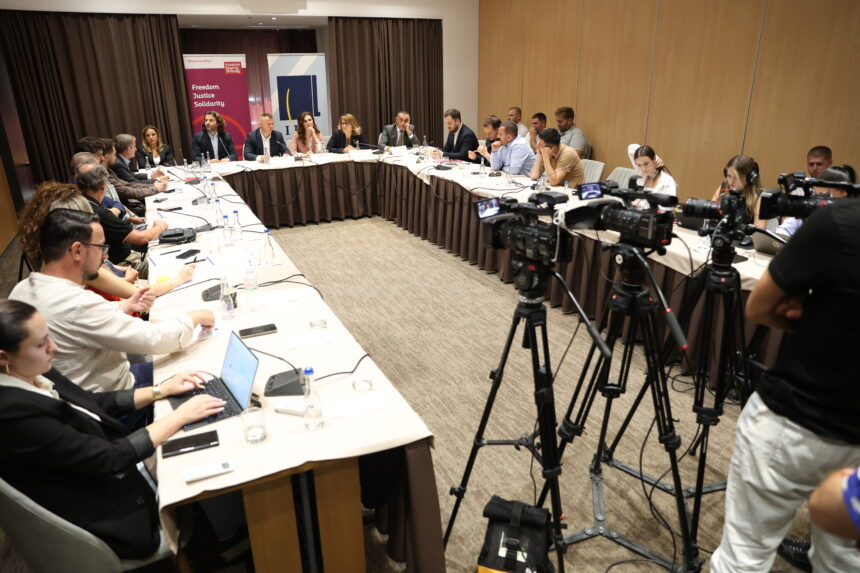
Pristina, August 1, 2025 – The Friedrich Ebert Stiftung (FES), Pristina Office, in cooperation with the Kosovo Law Institute (KLI), organized today a discussion meeting with Members of Assembly from the political parties represented in the Assembly of Kosovo. The aim was to analyze the current political and institutional situation and identify possible ways to resolve the deadlock that has prevented the constitution of the Assembly of Kosovo and the functioning of constitutional institutions.
The meeting, which focused on the topic: “Assembly on pause, democracy on trial: Is compromise and consensus the solution?”, brought together representatives of all parliamentary groups, as well as civil society and media representatives. The discussion centered on analyzing the responsibilities of each party, the consequences of the institutional crisis and the lack of parliamentary functionality, and the need for political reflection and maturity.
In his opening remarks, Ehat Miftaraj, Executive Director of KLI, stated that the greatest responsibility for the deadlock in the Assembly of Kosovo lies with the leading party, Vetëvendosje (LVV). He emphasized that Kosovo’s partner states are continuously calling for a solution, so that there is an institutional partner to advance development policies and reforms.
“Political parties should reflect, and without any doubt, responsibility lies according to the political strength that each party holds in the Assembly of Kosovo. Here, there is no amnesty, but the greatest responsibility lies with Vetëvendosje with its 48 MPs, who should find a solution to overcome this political deadlock, which I believe is turning into an institutional chaos. The longer we delay, the less recoverable the consequences will be.”
Miftaraj also spoke about the recent decision of the Supreme Court, which clearly determined that holding the positions of MA and minister simultaneously is incompatible with the Constitution and the law. He added that ministers and the Prime Minister make every decision in violation of the law.
He recalled that Kosovo is awaiting numerous agreements related to financial assistance from the European Union and other countries.
“The Kosovo Law Institute has consistently held that political parties should not expect miracles from the Constitutional Court, because even if a decision is made, it ultimately must be implemented by political parties.”
“The Constitutional Court defines procedures and, in a way, provides solutions based on the Constitution, but the solution ultimately rests with political parties, which must overcome their own positions to find a compromise.”
Egzon Osmanaj, Program Manager at Friedrich Ebert Stiftung (FES), said that parliamentary deadlocks are not merely procedural issues but directly affect citizens’ well-being.
“Our democracy is young, and all these challenges are part of the strengthening process. However, it is the duty of political parties, civil society, media, and above all, the government and opposition, to ensure that democracy is not harmed.”
“There is no democracy without debate, and there is no democracy without building bridges to overcome political differences.”
Speaking on behalf of LVV, MA Nezir Kraki stressed that he does not see it appropriate for the deadlock to continue based on some claims that, according to him, have no basis.
“The situation can change, votes can change, even percentages. Therefore, it is not acceptable to block the entire process, to block Kosovo, with consequences that could be even more severe in the coming days or weeks. It is not acceptable for this deadlock to persist based on one or two baseless claims.”
“Compromise should be self-evident in politics. This requires a higher political culture so that consensus is realized naturally. We have not reached that level yet, because the Constitutional Court cannot rely on the goodwill of political parties. I am not in favor of the Court transferring some sort of right to us to negotiate.”
From the Democratic Party of Kosovo (PDK), MA Vlora Çitaku stated that the state is not on pause but under a grip.
“What we are witnessing for several months is a grip, an attempt to completely overturn the constitutional order in the Republic of Kosovo.”
“For me and many of us, the Assembly of Kosovo is not merely a brick building where we sit and collect a salary at the end of the month. It is the place where we declared Independence, adopted the Constitution, established institutions, ratified important international agreements, and mostly, Mr. Kraki, reached consensus.”
MA Hykmete Bajrami from LDK said that the ruling party, LVV, is insisting that Albulena Haxhiu, proposed for Assembly Chair, is more important than the state, democracy, and the Republic.
“They insist that Albulena Haxhiu is more important than anything: democracy, the state, the Republic. We disagree with this.”
“Sometimes the demands toward former opposition parties sound like ‘submit.’ We are sorry, but submission is not in our plan.”
She added that it is not only a state-grip but self-imposed, because the grip is being applied by the party currently in power.
MA Lahi Brahimaj from AAK said the acting Prime Minister and his MAs maintain this situation to capture all levels of institutions.
“The interest of LVV has not been to form Parliament. Out of 54 sessions, more than 50 were incomplete due to the absence of LVV MAs.”
“The Alliance, from day one, has proposed solutions. I personally proposed two names: Shqipe Selimi and Saranda Bogujevci. Later, Mr. Haradinaj, seeing the situation, proposed Mr. Glauk Konjufca. Other parties also offered many solutions, but the insistence remained on Ms. Haxhiu’s candidacy.”
“The decision left much room for interpretation. The Court says to return to previous practices; secret voting is allowed if it starts from the first session and if all parties agree.”
MA Arbëreshë Krasniqi from the Social Democratic Initiative said Kosovo needs constructive debate and that responsibility is shared.
“When someone disagrees with another, the risk is inconsistency with oneself. We must always stop before pointing fingers at someone else; in this case, the leading party. We need to direct the finger at ourselves, in terms of responsibility and translating citizens’ trust into institutional opportunities and economic development.”
“Every political subject has tried and made efforts, but there has been a lack of possibility to find cooperation and constructiveness, and at the same time, the possibility to move forward has not been given.”
“Besides losing €900 million from the EU economic growth plan, Kosovo is also facing a loss of citizens’ trust in its institutions.”
Eugen Cakolli from KDI said that for the first time in Kosovo’s history, political competition has turned into a race for blame.
“The biggest problem is that, for the first time, we are in a situation where the competition is not about who forms institutions, but who is left with the blame for failing to form them.”
“For the first time, we have a Constitutional Court reminding political parties, especially those who received the most votes, that compromise is the core value of democracy. Not necessarily consensus, because we do not always agree on everything, but compromise is the key in this situation.”
“I do not understand what has changed since then. Maybe the desire has changed, or the lack thereof, to form a government with 61-62 votes. But in principle, what we have not seen in recent weeks or months are sincere efforts for compromise.”
“Although there have been offers from all sides, essentially none of them has been sincere.”
The discussion concluded with a call for political parties to urgently reflect in order to stop institutional degradation and ensure the functionality of the Assembly, with the aim of protecting public interest and the democratic future of the country.