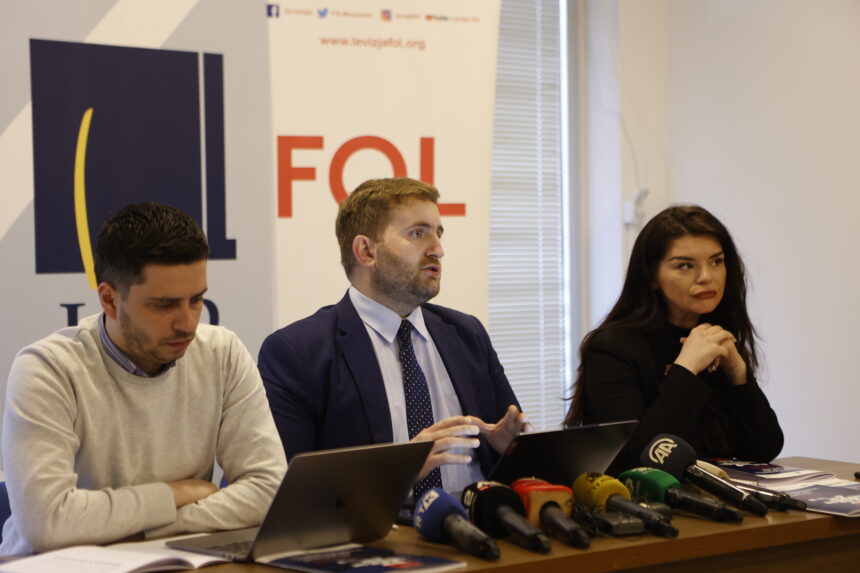
Pristina, February 6, 2025 – The Kosovo Law Institute (KLI), FOL Movement, and the Initiative for Progress (INPO), with the support of the Rockefeller Brothers Fund, published through a press conference the report titled “Integrity of Candidates, Rule of Law, and Good Governance.” The report presents an analysis of candidate lists and political programs for the February 9, 2025 general elections.
The report was presented by researchers Arbër Kadriu (INPO), Burbuqe Kastrati (FOL), and Gzim Shala (KLI), who outlined the key findings of the analysis. It addresses major issues related to certified candidates with legal problems, as well as provides a qualitative assessment of the political programs of certified parties, focusing on rule of law, good governance, and human rights.
Regarding the candidate lists, three political entities — Vetëvendosje Movement, the AAK–Nisma coalition, and the Democratic League of Kosovo (LDK) — have included a total of 23 candidates with legal issues (about 7% of their candidate lists). Vetëvendosje has the highest number, with 14 candidates (12.72%), followed by AAK–Nisma with eight candidates (7.27%), and LDK with one candidate.
Of the 23 candidates with legal issues, 16 face active indictments, while eight have final convictions. In total, 20 indictments have been filed against these candidates for 21 criminal offenses, including corruption-related crimes such as “abuse of official position or authority,” as well as other criminal acts like use of weapons or dangerous tools (nine cases), unauthorized possession of weapons (five cases), obstruction or assault against official persons, and other forms of criminal behavior.
The report further emphasizes that political party programs on justice for the 2025 elections vary significantly in both approach and seriousness.
Vetëvendosje Movement addresses justice only on one page of its program and makes no reference to the Rule of Law Strategy. It proposes the creation of a Family Court, a Specialized Prosecution Office, and an Office for Disciplinary Investigations, but without any in-depth analysis of their necessity or functionality. The lack of a detailed plan and the duplication of existing mechanisms make the program appear superficial.
In contrast, the Democratic League of Kosovo (LDK) offers a more comprehensive approach, covering issues such as vetting, integrity of the justice system, restoration of independence for the Free Legal Aid Agency, and digitalization of services. However, the program lacks detailed analysis and, again, does not reference the Rule of Law Strategy. Some proposals, such as strengthening the criteria for the bar exam and judicial appointments, remain unclear and insufficiently reasoned.
The Democratic Party of Kosovo (PDK) includes 14 points in its justice chapter, highlighting anti-corruption strategies and judicial reform. However, this program also omits any mention of the Rule of Law Strategy. It proposes the establishment of a National Bureau of Investigation, but this institution would duplicate the competences of the Special Prosecution Office and could result in excessive oversight of the judiciary. The program also foresees a National Strategy for War Crimes and the creation of a Labor Court, but again, without clear justification for the need for such an institution.
The AAK–Nisma coalition identifies the rule of law as its main priority but fails to offer concrete proposals for its implementation. Its Coalition for the Family program contains 15 points on justice, yet without detailed explanations on their implementation. Other parties, such as the New Democratic Initiative of Kosovo and Partia Fjala, address the rule of law in very general terms, with no concrete measures.
The report also examines other issues from the 2025 election programs, including transparency, good governance, public administration, gender equality, and human rights. While many programs mention these topics, most fail to provide clear details on implementation mechanisms or financial resources for the proposed reforms. Both PDK and LDK emphasize transparency and digitalization, but without explanations on how these reforms will be achieved. AAK promises economic development and salary increases in the public sector, yet without a clear budgetary plan. The Coalition for the Family and smaller parties such as the Egyptian Liberal Party and PDAK-LPB mention rule of law and equality but lack well-defined strategies for implementation.
The report concludes that Vetëvendosje’s program focuses mainly on infrastructure projects, omitting key governance topics such as public administration, transparency, and accountability. The reform of the public administration system — one of the most debated issues of the previous mandate — is not addressed at all, nor is the non-implementation of the Constitutional Court’s judgment on the Law on Salaries in the Public Sector.
Overall, the report finds that most electoral programs lack concrete measures to ensure a depoliticized and efficient public administration. Gender equality and human rights are mentioned only superficially, without actionable plans for practical implementation. Similarly, although some programs refer to anti-corruption efforts and the strengthening of independent institutions, they lack details on specific mechanisms to ensure accountability and clean governance. As such, the report concludes that the majority of electoral promises remain general and without a well-defined strategy for effective implementation.